
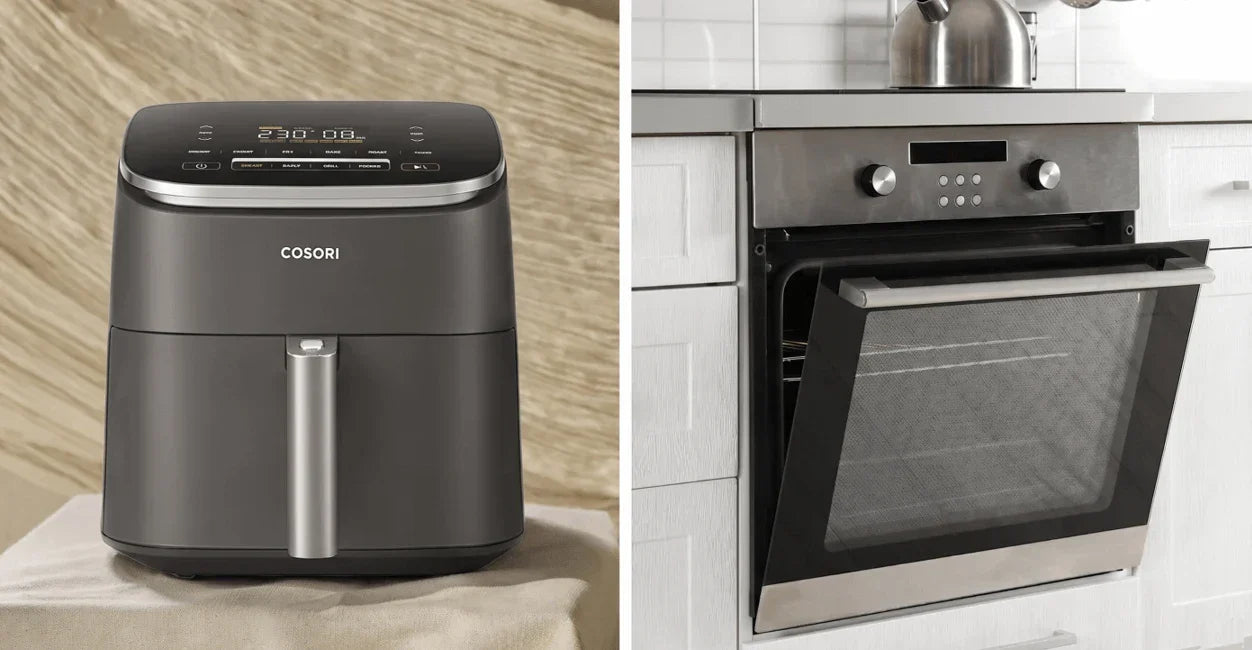
Both use hot air. Both promise crispy, evenly cooked food. Yet, with energy prices remaining a major focus for UK households, choosing between an air fryer and a conventional fan oven has become more than just a matter of taste — it’s about saving time, enhancing convenience, and reducing your daily running costs.
While they might seem to do the same job on the surface, the mechanics behind them dictate how they should be used. The decision of which appliance to fire up ultimately comes down to three crucial factors:
- Running costs: Which appliance uses less electricity for your specific meal?
- Capacity: How many people are you cooking for, and what volume of food is required?
- Speed: How fast do you need to get your dinner on the table after a long day?
How to Choose: Quick Guide
An air fryer excels at fast, highly energy-efficient cooking for smaller households or side dishes, while a traditional oven remains the undisputed champion for high-volume batch cooking, large family gatherings, and delicate baking tasks.
Choose an air fryer if:
- You actively want to save money on your daily energy bills.
- You typically cook for 1 to 4 people.
- You prioritise fast preheat times and crave deep-fried crispiness with significantly less oil.
- You want an appliance that won't heat up your entire kitchen during the summer.
Choose a fan oven if:
- You regularly cook large meals for 5 or more people.
- You are baking large batches of biscuits, delicate cakes, or roasting oversized joints of meat like a massive Sunday roast.
- You need to cook several different dishes at different temperatures simultaneously using multiple shelves.
What Is an Air Fryer?
An air fryer is a compact countertop appliance that uses rapid air technology to circulate hot air at high speeds around food. Because the basket is enclosed and the airflow is highly concentrated, heat reaches the food from all angles instantly.
Most models range from 2 to 9 litres in capacity. This makes them perfect for everyday dinners, reheating leftovers, or cooking frozen foods much faster than a standard oven.

What Is a Conventional Fan Oven?
A conventional oven uses radiant heating elements to warm a large cavity. A fan oven (which is the standard built-in oven in most UK kitchens today) improves upon this basic design by adding a fan at the back to actively circulate the hot air, resulting in more even cooking and slightly faster times than older, static ovens.
While a fan oven mimics the basic mechanics of an air fryer, its large size means it moves heat far less aggressively. The oven's clear advantage is sheer volume. With multiple shelves, you can easily fit large roasting tins, massive casserole dishes, or full baking trays with ease.
The UK Running Cost Breakdown: Let's Do the Math
When comparing an air fryer to an oven, energy usage is undoubtedly the most frequently asked question. To understand the real-world impact, we need to look at the numbers based on typical UK energy rates.
Because an air fryer has a much smaller cooking chamber, it requires significantly less energy to reach its target temperature. A standard built-in electric oven can take 10 to 15 minutes just to preheat. In contrast, an air fryer is ready to cook in 1 to 4 minutes.
The Cost Comparison:
Let's assume an average UK electricity rate of roughly 28p per kWh.
- Using an Air Fryer (e.g., 1500W): Cooking a meal for 20 minutes uses about 0.5 kWh of energy. Cost: ~14p.
- Using a Fan Oven (e.g., 2500W): Cooking the same meal might require 15 minutes of preheating and 30 minutes of cooking (45 minutes total). This uses roughly 1.8 kWh. Cost: ~50p.
While a saving of 36p per meal might not sound like a lottery win, if you use an air fryer four times a week instead of your oven, that equates to a saving of over £74 a year. For short cooking cycles and everyday meals for up to 4 people, an air fryer is noticeably cheaper to run.
However, a word of caution: That energy advantage reverses if you are cooking a massive family meal that requires running your air fryer through three or four separate batches. In those high-volume scenarios, heating your fan oven once is much more efficient.
Side-by-Side Comparison
| Feature | Air Fryer | Conventional Fan Oven |
|---|---|---|
| Running Cost (Small Meals) | Low (Highly efficient) | High (Wastes energy heating empty space) |
| Preheat Time | 0–4 minutes | 10–15 minutes |
| Cook Speed | Very Fast (Up to 50% quicker) | Moderate |
| Crispiness & Texture | Excellent (Intense, concentrated airflow) | Good to Moderate |
| Best Used For | Everyday meals, chips, wings, reheating | Batch cooking, large roasts, delicate baking |
| Cleaning | Very Easy (Dishwasher safe drawers) | Time-consuming & labour-intensive |
Specific Food Match-Ups: Air Fryer vs Oven
Understanding the technical differences is one thing, but how do they compare when it comes to the actual food on your plate? Here is how the two appliances handle kitchen staples.

Chips and Roasted Vegetables
Winner: Air Fryer
For high-surface-area foods like homemade chips, potato wedges, or Brussels sprouts, the air fryer consistently wins. The perforated basket design allows hot air to hit the underside of the food simultaneously—something a flat baking tray in an oven cannot replicate without you having to manually turn the food halfway through. The result is a much crispier exterior with a fluffy inside, using a fraction of the oil.
Whole Roast Chicken
Winner: Tie (Depends on Size)
An air fryer will cook a small to medium whole chicken significantly faster than an oven, yielding incredibly crispy skin while keeping the breast meat juicy, as the rapid cooking prevents it from drying out. However, if you are roasting a massive 3kg turkey or cooking a chicken alongside large trays of potatoes and root veg, the oven's superior capacity makes it the undisputed winner.
Baking (Cakes, Biscuits & Breads)
Winner: Fan Oven
While you can bake in an air fryer, the intense overhead heat and aggressive fan speed can sometimes be a disadvantage for delicate items. An air fryer might blow the wet batter of a light sponge cake sideways, or burn the top before the middle has set. A fan oven provides a gentler, more spacious environment that is perfect for achieving an even bake across multiple trays of biscuits or a large Victoria sponge.
Reheating Leftovers
Winner: Air Fryer
Forget the microwave. If you are reheating leftover pizza, fried chicken, or pastry, the microwave will make it soggy, and the oven will take 20 minutes to heat up for a 5-minute job. The air fryer brings leftover foods back to their original crispy glory in just 3 to 5 minutes, making it the ultimate reheating tool.
Cleaning & Maintenance: Which Is Easier?
Nobody enjoys cleaning the kitchen after a long day, which is another area where these two appliances diverge significantly.
Cleaning an Air Fryer:
Because the cooking process is contained within a removable drawer or basket, the mess never touches the actual heating elements of the machine. Most modern air fryers feature non-stick baskets that can be washed in the sink with warm soapy water in under a minute. Many models even feature completely dishwasher-safe components, making cleanup virtually effortless.
Cleaning a Fan Oven:
Oven cleaning is notoriously one of the most hated household chores. Fat and grease from roasting meat splatter against the walls, ceiling, and glass door, eventually baking on and requiring harsh chemical cleaners, wire brushes, and plenty of elbow grease to remove. While some high-end ovens have self-cleaning (pyrolytic) functions, these cycles take hours and use a massive amount of electricity.
Who Actually Doesn't Need an Air Fryer? (The Anti-Sell)
Air fryers are incredible tools, but they aren't magic boxes for absolutely everyone. To be completely objective, you might want to skip buying an air fryer if:
- You cook exclusively liquid-based meals: If your diet consists entirely of soups, stews, curries, and boils, an air fryer offers no benefit over a slow cooker or a standard hob.
- You have a massive household and minimal counter space: If you are cooking for 7 or 8 people every single night and have zero spare room on your kitchen worktops, constantly running multiple small batches in a compact air fryer will cause more frustration than convenience. In this case, investing in a high-quality fan oven is your best route.
FAQ
Is an air fryer cheaper to run than an oven?
Yes, in most everyday scenarios. Because it preheats almost instantly and cooks 20-50% quicker, an air fryer uses noticeably less electricity per meal than heating up a large electric oven, provided you aren't doing multiple back-to-back batches.
Can an air fryer cook healthier food?
Neither appliance inherently makes food healthier — that depends entirely on your ingredients. However, an air fryer achieves deep-fried, crispy results using up to 85% less oil than traditional deep frying methods. Compared to oven roasting, the oil usage is relatively similar, but the air fryer's basket allows excess fat to drip away from the food rather than letting the food sit in it on a tray.
Can an oven replace an air fryer?
Some modern premium ovens feature an "air fry mode," which increases fan speed to mimic the effect. While decent for large batches, the massive cavity means it still takes much longer to preheat and cannot match the intense, concentrated crispiness of a standalone countertop air fryer.
Can I convert oven recipes for an air fryer?
Yes! Because an air fryer cooks faster with concentrated heat, a general rule of thumb is to reduce the suggested oven temperature by 20°C and check the food 20% earlier than the recipe states. For precise, tested cooking times, always refer to your Cosori recipe book or our dedicated smart app.