
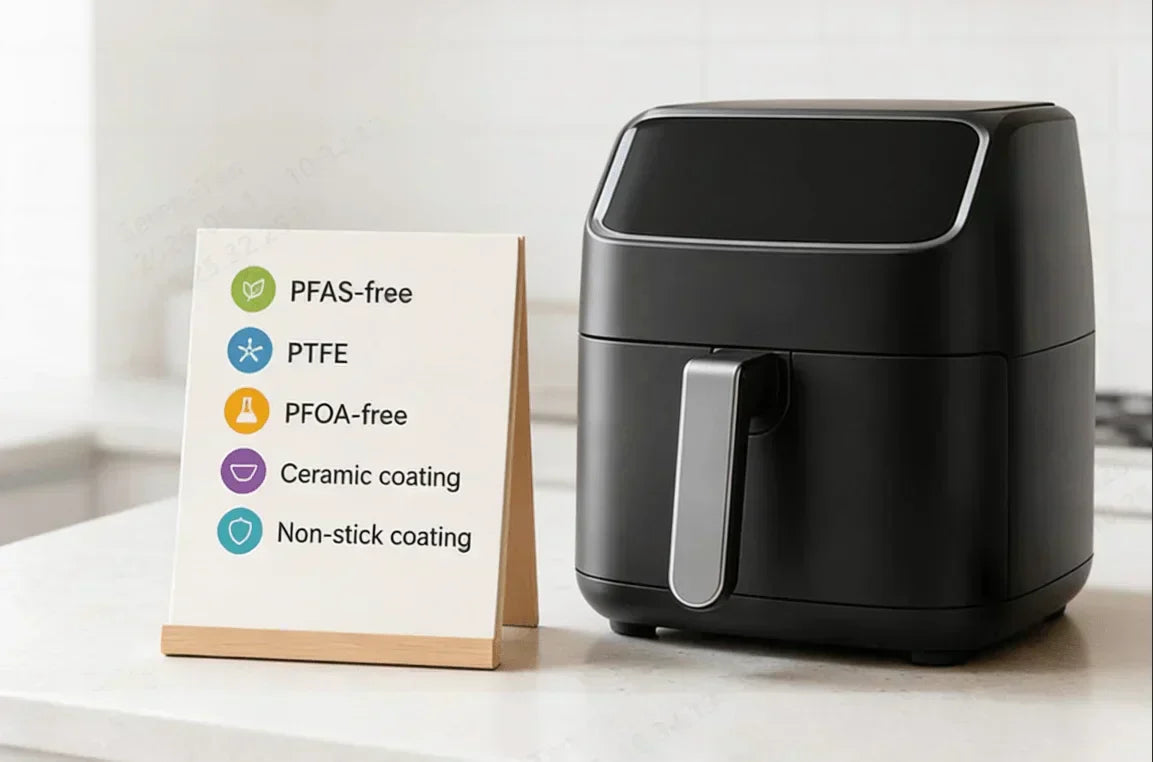
When shopping for an air fryer, many people compare size, cooking functions, ease of cleaning, and countertop footprint. More recently, shoppers have also started paying closer attention to material-related terms such as PFAS-free, PTFE, Teflon, PFOA-free, non-stick coating, and ceramic coating.
These terms can be confusing because they do not all mean the same thing. Some refer to broad chemical groups, some refer to specific substances, some refer to material types, and some are used in consumer-facing product descriptions.
This guide explains what these terms may mean in the context of air fryers and how to read material claims more carefully.
The goal is not to label one type of air fryer as good or bad. Instead, it is to help shoppers understand product language, compare specifications, and recognize that material claims should always be read as product-specific and component-specific.
Table of Contents
- What Are PFAS?
- What Does “PFAS-Free” Mean in an Air Fryer?
- PFAS, PTFE, Teflon, and PFOA-Free: What’s the Difference?
- Does “PFOA-Free” Mean “PFAS-Free”?
- Does “Without Teflon” Mean PFAS-Free?
- Is Ceramic Coating Always PFAS-Free?
- What Components Do Material Claims Usually Refer To?
- Why Product-Specific Language Matters
- How to Read Air Fryer Material Claims
- Common Air Fryer Material Terms Explained
- Practical Checklist for Shoppers
- Common Misunderstandings About PFAS-Free Air Fryers
- Why Care and Maintenance Still Matter
- FAQ: PFAS-Free Air Fryer Material Terms
- Final Thoughts
What Are PFAS?
PFAS stands for per- and polyfluoroalkyl substances. PFAS are not one single chemical. They are a large group of substances that have been used in various applications because of properties such as resistance to water, oil, grease, stains, and heat.
In consumer product discussions, PFAS may come up in relation to materials or coatings used in different industries. However, the presence, absence, or relevance of PFAS depends on the specific product, material, component, and claim being made.
For air fryers, the most important point is this:
PFAS is a broad category. A PFAS-free statement should be understood only in relation to the specific product, component, or surface for which the claim is made.
That means a claim may apply to a basket, tray, coating, or other stated food-contact surface, but it should not automatically be assumed to apply to an entire appliance, every accessory, or every model in a product line.
What Does “PFAS-Free” Mean in an Air Fryer?
In the context of air fryers, a PFAS-free claim usually refers to a specific material, coating, or component identified by the manufacturer.
For example, a product description may refer to:
- a PFAS-free basket coating,
- a PFAS-free crisper plate,
- a PFAS-free food-contact surface,
- or another clearly identified component.
The exact meaning depends on the wording of the claim. This is why it is important to look at the complete product description rather than relying only on a headline or short label.

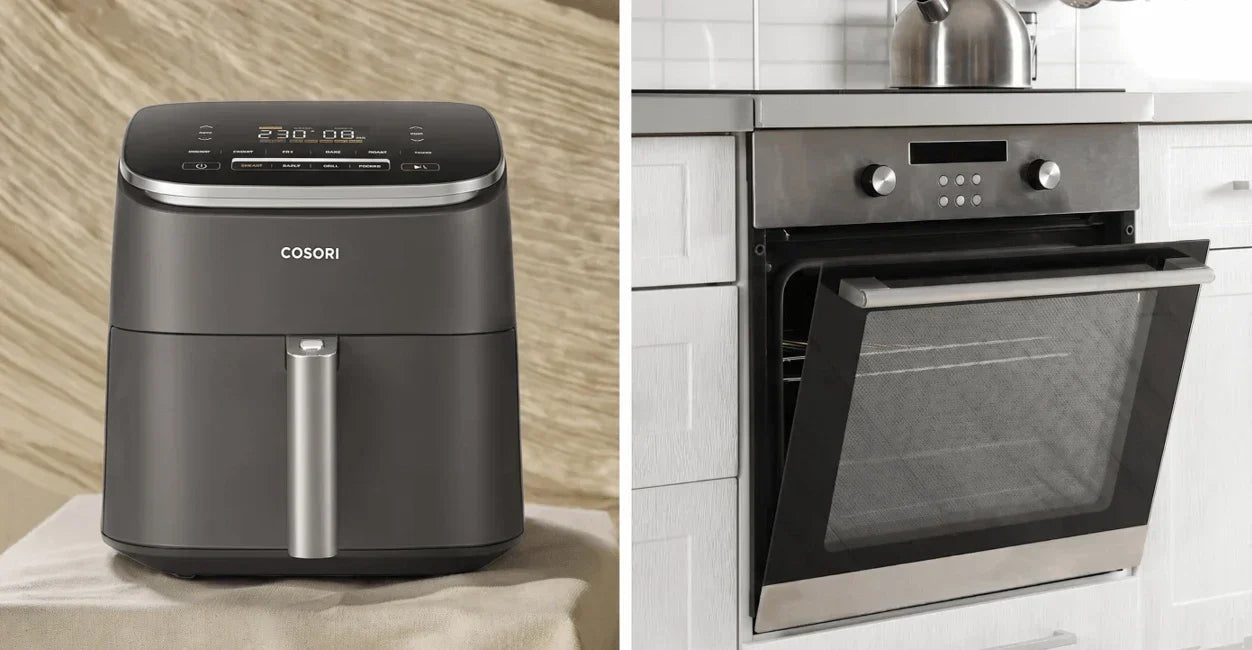
COSORI Turbo Tower Compact 8.6-L Air Fryer
A more specific statement, such as “PFAS-free basket coating,” is different from a broad or general statement. Shoppers should check which component is being described and whether the claim applies to the basket, tray, coating, food-contact surface, or another part of the appliance.
A useful rule is:
PFAS-free claims should be read narrowly and specifically. They should not be automatically extended to other components, products, models, or product lines.
PFAS, PTFE, Teflon, and PFOA-Free: What’s the Difference?
Terms such as PFAS, PTFE, Teflon, and PFOA-free are often mentioned together, but they should not be used interchangeably.
PFAS
PFAS refers to a broad group of substances. A PFAS-free claim should always be understood in relation to the specific product, component, or material being described.
PTFE
PTFE is a type of fluoropolymer often associated with non-stick applications. It is sometimes discussed in relation to PFAS because of its chemical category and use in certain coating systems.
However, the term PTFE should not be treated as identical to PFAS-free or PFOA-free. Each term has a different meaning.
Teflon
Teflon is a trademarked brand name that is commonly recognized by consumers in connection with certain non-stick coating technologies.
Because Teflon is a trademark, it should be used carefully and only for illustrative or explanatory purposes. It should not be used as a generic label for all non-stick coatings, and it should not be used in a way that makes unsupported negative claims.
PFOA-Free
PFOA is one specific substance within the broader PFAS-related discussion. A PFOA-free statement should not be treated as the same thing as a PFAS-free statement.
In simple terms:
PFAS-free, PFOA-free, PTFE, and Teflon do not mean the same thing. They should be read as separate terms with separate meanings.
Does “PFOA-Free” Mean “PFAS-Free”?
No. PFOA-free does not mean PFAS-free.
This is one of the most common points of confusion. PFOA refers to a specific substance, while PFAS refers to a much broader group. Therefore, a PFOA-free statement should not be used as a substitute for a PFAS-free statement.
When reading product information, shoppers should look for the exact wording used. If a product says PFOA-free, it should be understood as a PFOA-free statement. If a product says PFAS-free, it should be understood according to the specific component or material identified in that claim.
The two terms should not be merged or used interchangeably.
Does “Without Teflon” Mean PFAS-Free?
Not automatically.
The phrase “without Teflon” may be used by some consumers to describe a product that is not marketed with that specific trademarked coating name. However, this does not automatically mean the product carries a PFAS-free claim.
Because Teflon is a trademarked term, it should be used with care. It is more accurate to read the product’s specific material description rather than assume that “without Teflon,” “PFAS-free,” “PFOA-free,” “PTFE-free,” and “ceramic-coated” all mean the same thing.
A careful reading should focus on:
- the exact material claim,
- the component the claim applies to,
- whether the claim is product-specific,
- and whether the claim is clearly stated by the manufacturer.
The key takeaway is:
“Without Teflon” is not automatically the same as “PFAS-free.”
Is Ceramic Coating Always PFAS-Free?
No. Ceramic coating should not automatically be understood as PFAS-free.
“Ceramic coating” is a broad consumer-facing term used to describe certain types of coating systems. The exact formulation can vary by manufacturer, supplier, product, market, and model.
Some ceramic coatings may be marketed with a PFAS-free claim when that claim is specifically made for the relevant product or component. Other ceramic-coated products may not make such a claim.
Therefore, shoppers should avoid assuming that all ceramic coatings have the same material profile.
A practical way to understand it is:
- “Ceramic coating” describes a type of coating category or consumer-facing material term.
- “PFAS-free” is a specific material claim.
- The two terms are not automatically interchangeable.
If PFAS-free is an important criterion for a shopper, they should look for a clear product-specific statement identifying which component or coating the claim applies to.
What Components Do Material Claims Usually Refer To?
Air fryers are made from multiple materials and components. A material claim may refer to one part of the appliance, not the entire product.
Depending on the model, material descriptions may relate to:
- the cooking basket,
- the crisper plate or tray,
- the inner cooking surface,
- a coating applied to a food-contact component,
- the outer housing,
- handles or control panels,
- viewing windows,
- accessories.
This is why component-specific language matters.
For example, a claim about a basket coating should not automatically be understood as a claim about the outer housing, handle, electronic parts, packaging, or unrelated accessories.
When comparing products, shoppers should ask:
Which exact component is the claim describing?
That question is often more useful than asking whether an entire appliance can be described with one broad material label.
Why Product-Specific Language Matters
Material claims can vary by product, model, market, and version. Even products from the same brand may use different materials, coatings, or claim language.
This does not necessarily mean one product should be viewed negatively compared with another. It simply means material claims should be read in context.
A product-specific material statement may depend on:
- the component being described,
- the coating system used,
- the supplier specification,
- the test scope,
- the market where the product is sold,
- the product version,
- and the wording approved for that specific product.
For consumers, this means it is better to read the current product page, user manual, packaging, and official specifications rather than relying on assumptions based on a category term.
How to Read Air Fryer Material Claims
When reviewing material-related information for an air fryer, use the following framework.
- Identify the Exact Term Used: Check whether the product says PFAS-free, PFOA-free, PTFE, ceramic coating, non-stick coating, or another term. Do not assume these terms mean the same thing.
- Check the Component: Look for which part of the product is being described. Is it the basket, tray, coating, plate, cooking chamber, or another surface?
- Avoid Expanding the Claim: A claim about one component should not be expanded to the full appliance unless the product information clearly says so.
- Read the Product Page and Manual Together: Product pages often summarize key features, while manuals may include detailed use and care instructions. Both can help clarify how the product should be used and maintained.
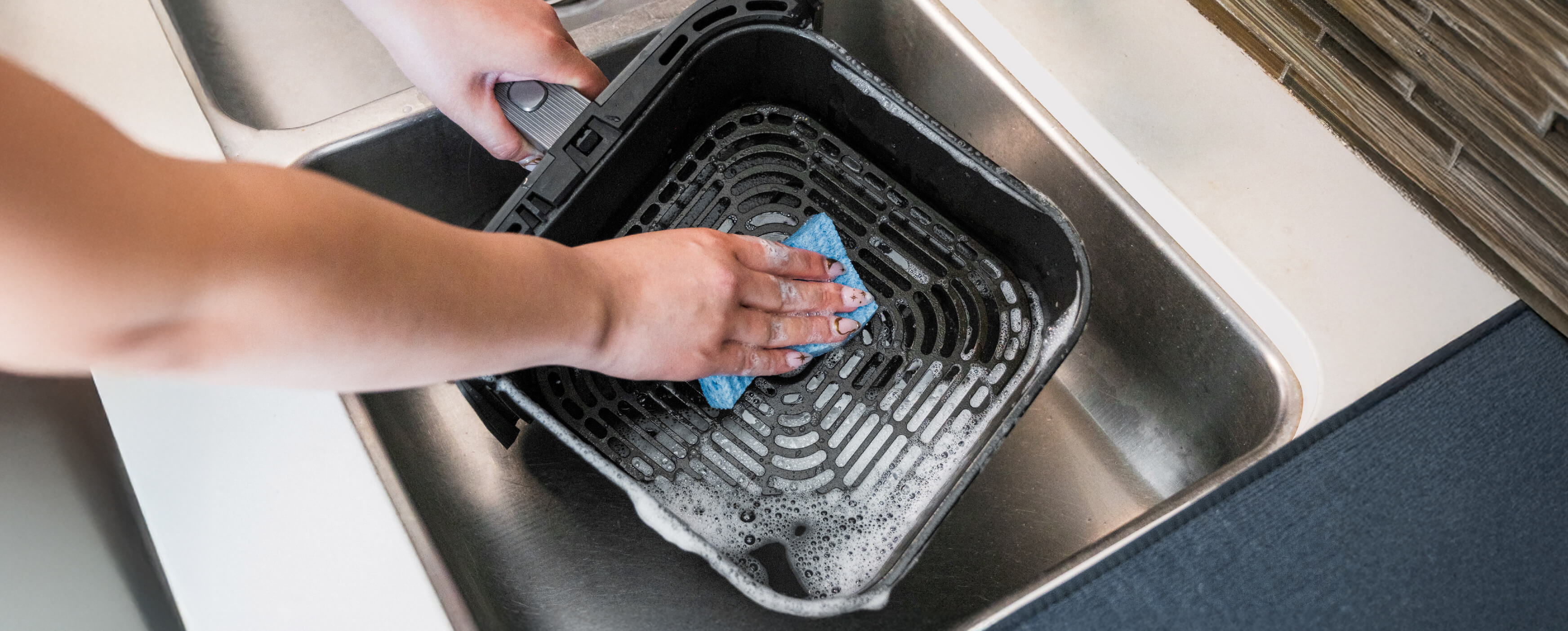
- Consider Care Instructions: Material claims do not replace proper use. Coated surfaces may require specific utensils, cleaning methods, or care practices.
- Compare the Full Product, Not One Word: Material information is one part of the decision. Capacity, temperature range, cooking performance, cleaning, accessories, storage, and ease of use also matter.
Common Air Fryer Material Terms Explained
Non-Stick Coating
A non-stick coating is designed to help reduce food sticking and make cleaning easier. Different products may use different coating systems, and the exact material description should be checked on the product page.
Ceramic Coating
Ceramic coating is a broad consumer term for certain coating systems. It should not automatically be interpreted as PFAS-free unless a specific PFAS-free claim is made for that product or component.
Stainless Steel
Stainless steel may be used in different parts of an air fryer, such as exterior styling, interior elements, racks, trays, or accessories, depending on the product. The exact use should be checked in the product specifications.
Plastic Components
Many kitchen appliances include plastic components, such as handles, housings, control panels, or other non-food-contact areas. The relevance of a material claim depends on which component is being discussed.
Glass or Viewing Windows
Some air fryers include a glass or viewing window so users can observe cooking progress. This is one design feature and should be considered alongside the full product construction.
Practical Checklist for Shoppers
Before choosing an air fryer, shoppers can use this checklist to read material claims more carefully:
- What exact material terms are used?
- Does the product say PFAS-free, PFOA-free, PTFE, ceramic coating, or non-stick coating?
- Which component does the claim apply to?
- Is the claim specific to the basket, tray, coating, or food-contact surface?
- Does the wording apply to the entire appliance or only one component?
- Are PFOA-free and PFAS-free treated as separate terms?
- Is Teflon mentioned only as an illustrative trademarked term?
- Does the product page explain cleaning and care instructions?
- Are there restrictions on utensils or cleaning tools?
- Does the product meet your needs for capacity, cooking functions, and daily use?
This approach helps shoppers avoid relying on a single keyword and encourages a more complete reading of product information.
Common Misunderstandings About PFAS-Free Air Fryers
Misunderstanding 1: PFAS-Free Means Chemical-Free
PFAS-free does not mean chemical-free. All materials are made of chemical substances, including stainless steel, glass, plastics, coatings, and food itself.
A more accurate interpretation is that PFAS-free is a specific material claim that should be read in relation to a particular product, component, or coating.
Misunderstanding 2: PFOA-Free Means PFAS-Free
PFOA-free and PFAS-free are not the same. PFOA is one specific substance, while PFAS is a broader group. These terms should not be used interchangeably.
Misunderstanding 3: Ceramic Coating Always Means PFAS-Free
Ceramic coating does not automatically mean PFAS-free. If a ceramic-coated product has a PFAS-free claim, the claim should be clearly stated for that product or component.
Misunderstanding 4: “Without Teflon” Automatically Means PFAS-Free
Not automatically. Teflon is a trademarked term commonly associated with certain non-stick coating technologies. The absence of that term does not automatically create a PFAS-free claim.
Misunderstanding 5: One Material Claim Describes the Entire Appliance
Not always. A material claim may apply only to a specific component, such as a basket coating or tray. It should not automatically be expanded to the entire appliance.
Why Care and Maintenance Still Matter
Regardless of the material or coating type, proper use and care are important for everyday cooking performance.
Shoppers should always follow the product manual, especially for:
- recommended utensils,
- cleaning methods,
- dishwasher guidance,
- temperature use,
- handling coated surfaces,
- replacement of damaged accessories,
- and general maintenance.
For coated baskets or trays, users should avoid metal utensils or abrasive cleaning tools if the manual advises against them. If a surface becomes visibly damaged, users should refer to the manufacturer’s guidance on continued use or replacement.
Material claims help describe a product, but they do not replace normal care instructions.
FAQ: PFAS-Free Air Fryer Material Terms
What does PFAS-free mean in an air fryer?
PFAS-free usually refers to a specific product, component, material, or coating identified by the manufacturer. It should not automatically be interpreted as a claim about the entire appliance unless the product information clearly states that.
Is PFOA-free the same as PFAS-free?
No. PFOA-free and PFAS-free are different terms. PFOA refers to a specific substance, while PFAS refers to a broader group. They should not be used interchangeably.
Is ceramic coating always PFAS-free?
No. Ceramic coating is not automatically PFAS-free. A ceramic-coated component should only be understood as PFAS-free if the product specifically makes that claim for the relevant component.
Does “without Teflon” mean PFAS-free?
Not automatically. Teflon is a trademarked term commonly associated with certain non-stick coating technologies. A product described as “without Teflon” should not automatically be treated as PFAS-free unless a specific PFAS-free claim is also made.
Does PFAS-free mean chemical-free?
No. PFAS-free does not mean chemical-free. It is a specific material claim, not a statement that a product contains no chemical substances.
Can a PFAS-free claim apply only to one component?
Yes. A PFAS-free claim may apply to a basket, tray, coating, or another stated component. Shoppers should check exactly which part of the product is being described.
What should I check before comparing material claims?
Check the exact wording, the component involved, the care instructions, and whether the claim is product-specific. Also compare practical factors such as capacity, cooking functions, cleaning, and ease of use.
Final Thoughts
Air fryer material terms can be useful, but they need to be read carefully. PFAS-free, PFOA-free, PTFE, Teflon, and ceramic coating are not interchangeable terms.
A PFAS-free claim should be understood as product-specific and component-specific. PFOA-free should not be used as a substitute for PFAS-free. Ceramic coating should not automatically be interpreted as PFAS-free. Teflon, as a trademarked term, should be used only in a limited and illustrative way.
When comparing air fryers, shoppers should look at the full product information: material descriptions, component details, use and care instructions, cooking functions, capacity, cleaning requirements, and everyday cooking needs.
The best approach is not to rely on a single label, but to understand what each material term actually says — and what it does not say.