

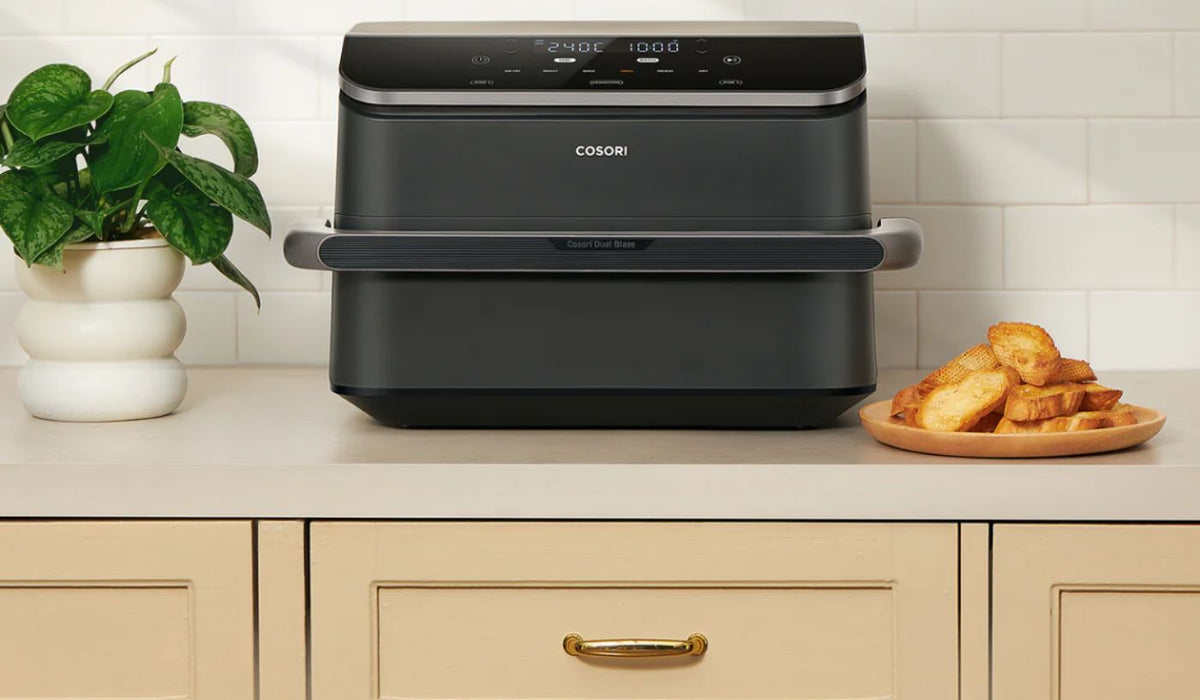
Great cooking starts with knowing your tools. An air fryer circulates hot air at high speed around a compact cooking chamber — and that concentrated heat cooks food faster and more efficiently than a conventional oven. Which means the times and temperatures you're used to from your oven won't translate directly.
This guide gives you a complete reference for air fryer cooking times across all major food categories, a simple formula for adapting your favourite oven recipes, UK food safety temperatures, and practical tips to help you get the best results every time.
Why Air Fryer Cooking Times Are Different
An air fryer's hot air circulates rapidly around a small, enclosed space, wrapping food in heat on all sides simultaneously. A conventional oven is larger, relies more on radiant heat, and doesn't move air as aggressively. The result: the same piece of chicken that might take 35–40 minutes in a standard oven can be done in 20–25 minutes in an air fryer.
Four variables directly affect how long things take:
- Food thickness: thicker cuts need more time; thin cuts cook quickly and can dry out if overdone. Add 3–5 minutes for every extra 13mm of thickness beyond the base recipe.
- Fresh vs frozen: frozen items generally need 2–5 additional minutes. No thawing required.
- Basket load: always cook in a single, even layer. A crowded basket restricts airflow, causing uneven browning and longer times.
- Starting temperature: proteins at room temperature for around 30 minutes before cooking tend to cook more evenly and slightly faster.
How to Convert Oven Recipes for an Air Fryer
Most oven recipes can be adapted for an air fryer with a simple two-step adjustment. The air fryer's efficiency means you need to reduce both temperature and time to avoid overcooking.
The Air Fryer Conversion Formula
Reduce temperature by 20°C · Reduce cooking time by 20–25%
Example: 200°C for 30 min in oven → 180°C for 22–24 min in air fryer
This is a starting point, not a guarantee. Food thickness, moisture content, and basket load will all influence the actual result. Always check a few minutes before the end of the time range and use a food thermometer for proteins.
Air Fryer Cooking Times Chart
The times and temperatures below are calibrated for a standard single-basket air fryer. Wattage, chamber size, and airflow design vary between models — treat these as a reliable starting point and adjust based on your results. Always check food a few minutes before the end of the time range.
Vegetables
Most vegetables need no added oil — a light spritz is enough to help them brown. Cut pieces to a consistent size so everything cooks at the same rate.
| Food | Temp (°C) | Time | Shake / Flip | Notes |
|---|---|---|---|---|
| Broccoli | 220°C | 5–9 min | Shake | Small florets |
| Brussels sprouts | 210°C | 8–16 min | Shake | Quartered |
| Carrots | 220°C | 10–16 min | Shake | Sliced |
| Cauliflower | 220°C | 8–14 min | Shake | Florets |
| Corn on the cob | 190°C | 10–18 min | Turn | Whole |
| Green beans | 210°C | 4–8 min | Shake | Whole |
| Mushrooms | 190°C | 8–14 min | Shake | Whole |
| Peppers | 200°C | 6–12 min | Shake | 25mm dice |
| Potatoes (cubed) | 200°C | 8–16 min | Shake | 25mm cubes |
| Jacket potato (whole) | 200°C | 50–60 min | — | 255–283g |
| Sweet potato (whole) | 200°C | 45–60 min | — | 255–283g |
| Courgette / Squash | 200°C | 8–14 min | Shake | 25mm slices |
| Asparagus | 185°C | 5–8 min | — | Whole spears |
| Aubergine | 220°C | 10–18 min | — | Halved |
Chicken & Poultry
Always verify doneness with a food thermometer. UK Food Standards Agency guidance is that poultry must be cooked all the way through: the middle of the food should reach 70°C for 2 minutes, or an equivalent combination such as 75°C for 30 seconds. If you don't have a thermometer, check that the meat is steaming hot throughout, with no pink meat and juices that run clear. Never rely on time alone.
| Food | Temp (°C) | Time | Shake / Flip |
|---|---|---|---|
| Breast (boneless, 227–283g) | 200°C | 15–22 min | Flip |
| Breast (bone-in, 283g) | 200°C | 24–34 min | Flip |
| Breast (thin cut, 142g) | 200°C | 10–18 min | Flip |
| Mini fillets (454g) | 200°C | 8–12 min | Flip |
| Wings (907g) | 205°C | 16–22 min | Shake |
| Drumsticks (6 pieces) | 200°C | 18–24 min | Flip |
| Thighs (bone-in) | 200°C | 18–24 min | Flip |
| Thighs (boneless) | 200°C | 8–14 min | Flip |
| Whole chicken (approx. 2kg) | 180°C | 55–60 min | — |
Beef & Pork
For steak, the times below assume a 25mm cut. The UK Food Standards Agency recommends pork reaches a core temperature of 75°C (or 70°C for 2 minutes). Steak doneness is a matter of preference — use the safe internal temperature guide below as your reference.
| Food | Temp (°C) | Time | Flip |
|---|---|---|---|
| Sirloin steak (25mm) | 230°C | 6–12 min | Flip |
| Boneless ribeye (25mm) | 230°C | 6–12 min | Flip |
| Bone-in ribeye (19–32mm) | 230°C | 6–14 min | Flip |
| Bavette / Flank steak (25mm) | 230°C | 8–14 min | Flip |
| Beefburger (13–19mm, 113g) | 230°C | 6–14 min | Flip |
| Kebab skewers (25mm cubes) | 230°C | 6–8 min | Turn |
| Pork chop (boneless) | 230°C | 6–14 min | Flip |
| Pork chop (bone-in) | 230°C | 8–16 min | Flip |
| Pork tenderloin (454g) | 200°C | 18–25 min | — |
| Meatballs (50mm) | 200°C | 10–14 min | Shake |
| Bacon (rashers) | 200°C | 5–8 min | Flip |
| Bacon (thick-cut) | 200°C | 6–10 min | Flip |
| Sausages (raw, 50mm) | 210°C | 7–12 min | Turn |
Seafood
Seafood cooks quickly and is easy to overcook. Check at the early end of the time range. The UK Food Standards Agency advises using visual cues to confirm fish is cooked: the flesh should turn opaque and separate easily with a fork, and prawns, scallops and lobster should be firm and opaque throughout.
| Food | Temp (°C) | Time | Notes |
|---|---|---|---|
| Salmon fillet (25mm) | 195°C | 6–12 min | — |
| Salmon fillet (thin, 12–19mm) | 195°C | 6–8 min | — |
| White fish fillet (25–50mm) | 195°C | 8–12 min | — |
| Prawns (large) | 230°C | 3–5 min | Shake |
| Scallops | 230°C | 3–7 min | — |
| Lobster tail | 195°C | 8–10 min | — |
| Squid rings (6mm) | 230°C | 5–9 min | Shake |
Frozen Foods
Most frozen foods go straight from freezer to basket — no thawing needed. Avoid overfilling: ice crystals release moisture as they heat, and a crowded basket will steam rather than crisp the food.
| Food | Temp (°C) | Time | Shake / Flip |
|---|---|---|---|
| Chicken nuggets | 200°C | 7–12 min | Shake |
| Chicken goujons | 200°C | 8–12 min | Flip |
| Mozzarella sticks | 200°C | 6–9 min | Flip |
| Onion rings | 200°C | 10–16 min | Shake |
| Chips (thin cut) | 200°C | 14–18 min | Shake |
| Chips (thick cut) | 200°C | 16–22 min | Shake |
| Sweet potato fries | 200°C | 14–18 min | Shake |
| Hash brown bites | 200°C | 16–24 min | Shake |
| Fish fingers | 200°C | 6–14 min | Flip |
| Spring rolls | 200°C | 6–10 min | Flip |
| Dumplings / Gyoza | 195°C | 6–12 min | — |
| Breaded prawns | 200°C | 7–12 min | Shake |
| Breaded fish fillets | 200°C | 8–16 min | Flip |
| Samosas | 200°C | 8–12 min | Flip |
Baked Goods
Use baking paper or a silicone mat to line the basket. Keep temperatures lower than you might expect — the enclosed chamber concentrates heat, and baked goods can brown quickly on top. Cover loosely with foil if the top starts to colour too fast.
| Food | Temp (°C) | Time | Notes |
|---|---|---|---|
| Cookies | 150°C | 10–14 min | Use baking paper |
| Cake (20cm round tin) | 150°C | 20–30 min | Cover with foil if top browns too fast |
| Cupcakes / Muffins | 150°C | 10–15 min | 120ml batter each |
| Cheesecake (15cm tin) | 140°C | 20–30 min | Cover with foil if needed |
| Quick bread (mini loaf) | 150°C | 25–35 min | Use a small loaf tin |
| Scones | 165°C | 11–15 min | — |
| Cinnamon rolls | 165°C | 10–15 min | — |
UK Safe Internal Temperatures
Time is a cue to check — not a guarantee that food is done. For all proteins, verify with an instant-read thermometer inserted into the thickest part of the food. The UK Food Standards Agency (FSA) does not set separate temperatures for each type of meat. Its guidance is that the middle of any food should reach 70°C for 2 minutes, or an equivalent time–temperature combination — in practice, 75°C for 30 seconds is the simplest single check.
| Food | Safe Core Temp (FSA) | Notes |
|---|---|---|
| Chicken & poultry | 75°C for 30 secs (or 70°C for 2 mins) | No pink meat, juices run clear |
| Pork | 75°C for 30 secs (or 70°C for 2 mins) | Includes sausages and mince |
| Minced beef / Beefburgers | 75°C for 30 secs (or 70°C for 2 mins) | Whole steak: see preference guide |
| Fish & seafood | No FSA core temperature — use visual cues | Flesh opaque and flakes easily |
| Whole beef / lamb steak | Can be served pink if the outside is properly seared | Rare: 54°C · Medium: 60°C · Well done: 71°C+ |
Tips for Better Results
Common Mistakes That Affect Cooking Times
Restricted airflow means food steams instead of crisps, and cooking times become unpredictable. Two smaller batches will consistently outperform one crowded basket.
Even, all-around browning requires turning food partway through. The chart above indicates which foods need it. Skipping this step is one of the most common reasons results come out uneven.
Most air fryers perform best when they reach the target temperature before food goes in. A 3-minute preheat is sufficient for most foods.
A timer is a cue to check — not a guarantee. For all proteins, always verify with an instant-read thermometer.
Traditional wet batters — beer batter, tempura — are not suited to air frying. For anything requiring a coating, use dry breadcrumbs or panko for clean, crispy results.
COSORI Turbo Tower™ Air Fryer Pro Smart — 10.8L
For households that cook seriously, the Turbo Tower Pro Smart combines a large 10.8-litre capacity with dual heating elements, 100% ceramic-coated food-contact surfaces (free from Teflon), and Wi-Fi control via the VeSync app.
- 100% ceramic coating — PFOA-free and dishwasher-safe
- Dual heating elements for even heat distribution
- 5-speed fan with Advanced Turbo Blaze Technology
- 7-in-1 functions including air fry, roast, bake, and dehydrate
- Wi-Fi controlled via the VeSync app with chef-created recipes
Frequently Asked Questions
Do I need to preheat my air fryer?
Yes, for most foods. A 3-minute preheat at the target temperature helps deliver consistent browning and accurate cooking times from the start. The main exception is hard-boiled eggs, which are placed into a cold basket.
Why are my cooking times different from the chart?
Basket load, food thickness, starting temperature, and moisture content all influence actual cooking time. The chart provides a reliable starting point — use a food thermometer and visual cues to confirm doneness and adjust from there.
Does an air fryer cook faster than a conventional oven?
Yes. An air fryer's compact chamber and rapid air circulation typically reduce cooking time by 20–25% compared to a conventional oven at the same temperature. That's why the conversion formula calls for reducing both temperature and time when adapting oven recipes.
Can I stack food in the basket?
In most cases, no. Stacking prevents hot air from reaching all surfaces evenly, resulting in soft spots and inconsistent cooking. Small items like chips or nuggets can be layered if shaken regularly, but proteins and anything requiring even crispiness should always be cooked in a single layer.
Do I need to add oil when cooking frozen food?
Most frozen foods don't require added oil. They typically already contain enough fat, and adding oil on top can make them greasy. The main exception is frozen vegetables, which benefit from a light spritz to help them brown.
Can I use baking paper or foil in my air fryer?
Yes, both work well. Always place food on top of the liner to weigh it down — a lightweight liner without food on top can be lifted by the fan towards the heating element, which is a fire hazard. Never cover the vents or block airflow.
Looking for an air fryer that keeps up with how you cook? Explore the full COSORI range.
Shop COSORI Air Fryers